
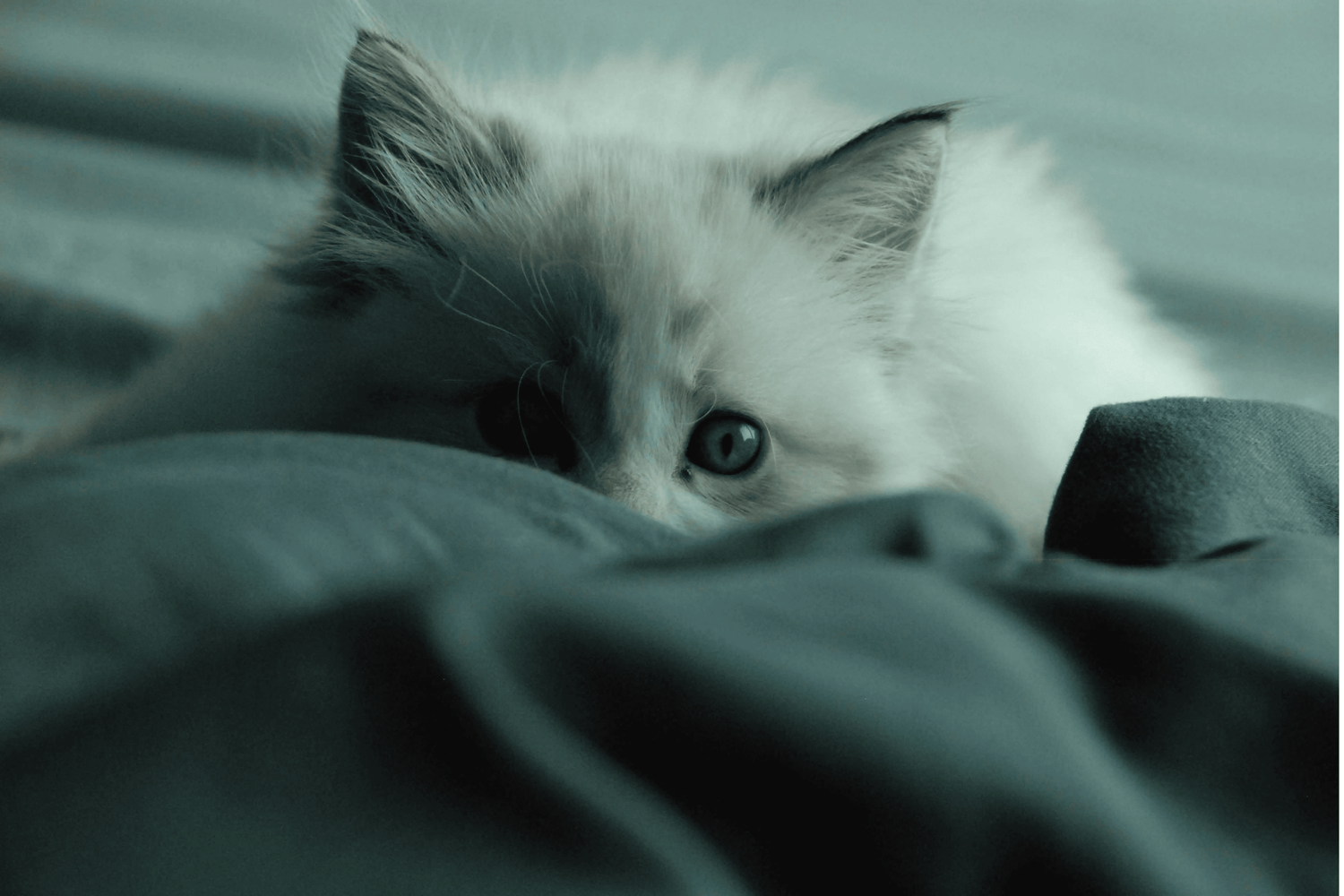
Stress in cats is often invisible. Unlike humans, cats rarely express anxiety in obvious ways. There are no verbal complaints, no clear signals that something is wrong. Instead, stress settles quietly into their daily behavior, shaping routines, reactions, and even health over time.
In clinical practice, many feline behavioral issues share the same underlying cause: chronic mental under-stimulation.
Cats are not passive animals. Their brains are wired for constant environmental analysis. In nature, a cat’s survival depends on its ability to observe, anticipate, and react. Every sound, movement, or scent carries meaning. Indoors, however, this flow of information is dramatically reduced. The environment becomes predictable, repetitive, and cognitively flat.
When a cat’s brain lacks stimulation, it does not simply “rest.” It compensates.
This compensation often appears as anxiety-related behavior. Excessive grooming, sudden agitation, unexplained meowing, or obsessive routines are not random habits. They are attempts by the nervous system to regulate itself in the absence of adequate cognitive engagement.
From a neurological perspective, mental stimulation plays a central role in emotional balance. When a cat engages in problem-solving, anticipation, or purposeful interaction, its brain releases dopamine and serotonin, neurotransmitters associated with pleasure, focus, and emotional stability. These chemical responses are not optional luxuries; they are biological necessities.
Without them, stress hormones such as cortisol remain elevated.
Chronically elevated cortisol affects the body in profound ways. It weakens immune response, disrupts digestion, interferes with sleep, and heightens sensitivity to environmental changes. Over time, a stressed cat becomes more reactive, less adaptable, and more prone to illness. This is why anxiety in cats often coincides with recurring health issues, despite no clear medical cause.
Mental stimulation acts as a natural regulator.
Activities that require a cat to think, anticipate, or adapt help shift the nervous system out of a constant state of alert. This is particularly important for indoor cats, whose environment rarely challenges their cognitive abilities. When stimulation is absent, even small changes, new noises, visitors, altered routines, can trigger disproportionate stress responses.
Interestingly, mental engagement does not need to be complex. Cats do not require puzzles or tasks designed for humans. What matters is meaningful interaction. Movement that reacts unpredictably, environments that offer choice, and objects that respond to touch all activate the brain areas responsible for focus and emotional regulation.
This explains why some cats appear calmer after play, even if the physical exertion was minimal. The calming effect is not solely physical it is neurological. The brain has completed a cycle of anticipation and resolution, reducing internal tension.
Another overlooked aspect of mental stimulation is autonomy. Cats experience stress when they feel a lack of control over their surroundings. Environments that offer interactive elements allow cats to initiate engagement on their own terms. This sense of agency is deeply reassuring and helps reduce anxiety-related behaviors.
Veterinary behaviorists often emphasize that a mentally fulfilled cat is more resilient. These cats adapt better to change, recover faster from stress, and display fewer behavioral issues. They are not constantly seeking stimulation because their needs are being met in a balanced way.
Mental stimulation also supports better sleep patterns. Cats with engaged minds during the day tend to experience deeper, more structured rest. This reduces nighttime restlessness and aligns the cat’s internal rhythm with its natural biological cycle.
In modern homes, stress is rarely caused by a single traumatic event. It builds gradually through repetition, monotony, and unmet instincts. Mental stimulation acts as a buffer against this slow accumulation, offering the brain what it evolved to expect: interaction, challenge, and purpose.
Understanding feline anxiety requires us to shift perspective. Calmness does not come from restriction or silence. It comes from engagement.
When a cat’s mind is occupied in the right way, stress has less space to grow.

Leave a comment
This site is protected by hCaptcha and the hCaptcha Privacy Policy and Terms of Service apply.